
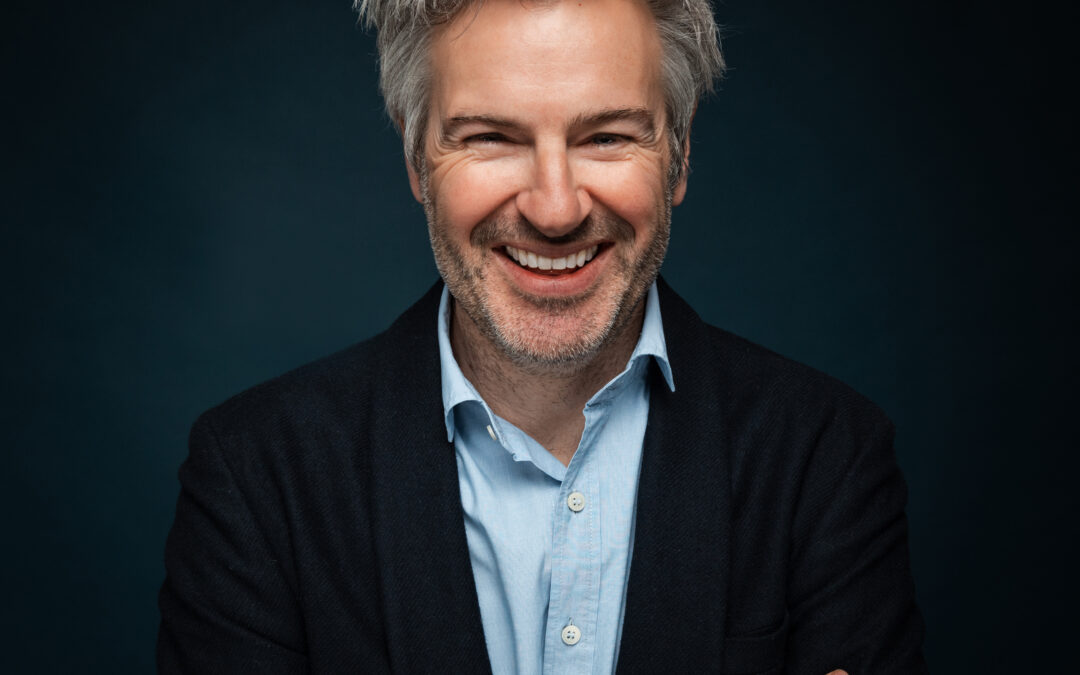
Mark Cuddigan led Ella’s Kitchen as their CEO for 12 and a half years. Ella’s Kitchen make delicious food for babies that has been created from high quality ethically sourced ingredients. They also offer lots of free guides to weaning, recipe ideas and top tips from experts.
The founder of Ella’s Kitchen, Paul Lindley set it up in 2006, and he asked Mark to come and join them.
‘What first attracted me and slightly surprised me as well, was that the main reason he set up at his kitchen wasn’t to make money. I found this very surprising. I had thought business was about looking after people and being socially conscious, but surely the main aim was to be commercially successful and make money.
This idea, back then, of having a purpose that was not related to money was both enticing and surprising if I’m honest. It was a sense of being part of something which was going to make a positive impact that excited me.
There was an authenticity and genuineness to it. From a very personal point of view, it felt like my home or my tribe.
Over a decade ago, Barack Obama said that “we’re the first generation of leaders who won’t be able to look back and say we didn’t know.” The idea is that business can be part of the solution; either to the social or environmental issues that we have. If a business can be part of the solution to those issues, then they are going to thrive. It’s so obvious with regards to so many things, whether it’s the environment, whether it’s society, whether it’s diversity, whether it’s having gender equality in the boardroom and senior team. Yes, these things are the right thing to do, but they’re also the smart thing to do.
All these ideas have completely changed me; my outlook on life, what I think’s important in life, what I drive for and how I am competitive. I think that has driven the success of Ella’s Kitchen. Of course, we can debate how you measure success, but we’ve won around 50 awards for all sorts of things. I hope we have created a beacon of goodness.
Business can make a difference.’
Having a sense of purpose is something that is often talked about in the B Corp world, and I was interested to know how important Mark thought a sense of purpose was in attracting and retaining talent.
‘I think personal development and continuous learning have a positive impact.
I think you can only get fulfilment at work, whatever work you’re doing, through helping other people. If we can make that a part of our business model in some way, you’re going to have a happy start. If you have a happier fulfilled team, you are going to be more successful, you’re going to be able to recruit the best people, you’re going to be able to retain the best people.
It’s this great, virtuous circle.
Having authenticity in your purpose really shines through. That’s what is so successful. It’s having people that are connected to each other, work with each other and collaborate. That’s what creates a high-performance team and the results will then follow.
I think people want pride in the work that they do. And you can’t have pride in the work that you do if you’re not empowered or if you don’t have autonomy.’
We also talked about the challenges and difficult times the business has faced, and how Mark led them all through it
‘The most difficult challenge I’ve ever had was when my managing director passed away suddenly. I believe leadership is being in service to others. It is a privilege to lead people but I made the mistake of putting others before myself and that wasn’t good because I was struggling as much as others. So you have to look after yourself before you can look after others. It was a horrific time.
Of course, there are tough times every day. That’s part of dealing with a group of individuals and running complex businesses.’
Leadership requires a range of skills and strengths every day, and we discussed the qualities that Mark sees as really essential, especially as a B Corp leader.
‘I try to inspire, engage and support the people that work for us. I talked to my 11 year old and my 13 year old a few months ago because they’re breaking through a tough time of school. And I was saying to them that I think that one of the most important attributes that we can have is resilience. Because all sorts of stuff is going to happen to us that we’re going to have to put up with. We’re going to have to deal with death of loved ones, bullying at school, poor results, anxiety, mental health issues, divorce. Life is really really hard.
As a leader, you need to have resilience because, if you’re putting others before yourself, it’s a big ask and it’s really, really difficult. Don’t get me wrong, it’s a huge privilege. But you need to be resilient to be able to do that and do that well.
I wouldn’t want to say there’s one way of doing it but for me, leadership is trying to inspire and put others before you. Lift them up, so they can be the best that they can be. Create the conditions where they can thrive and then support them. It’s about them. It’s not about you.
Looking back, the people that I know had the most challenges at school, and were the least likely to be successful, are the ones that have been the most successful. When life’s been really easy, it raises your expectations and then when there’s a speed bump, you can’t really deal with it.
I guess it’s to do with having more self-awareness. That taps into leadership. I did a talk at a girls’ school. And this girl put her hand up and asked, “What’s the one thing I need to get really good at if I’m going to be a CEO?” I said, I think you need to be self-aware. I asked her, ”Do you understand what I mean by that?” She had no idea. And I said, “It’s being aware of the impact that you’re having on other people, whether it’s a raised eyebrow or a shake of the head, because our faces give away so much. The words that you say are critically important.”’
Developing new leaders is critically important for any business, and Mark shared some advice for them.
‘Try to constantly put yourself in other people’s shoes. Don’t assume that everybody knows what you do. Enjoy yourself because if you’re not having fun, you’re not going to be your best self and try to be self-aware.
It’s also our responsibility to lift up the people that work for us. I remember this guy called Peter Darko who used to be a pilot in the RAF. He was once walking through his office and his boss stopped him, saying “Can I just ask your opinion about something?” He shared his opinion, and his boss listened. Peter said he felt seen and heard, which made a real difference.
I did a talk to a couple of 100 NHS consultants about the importance of autonomy in a business. The Head of the Nurses’ Union asked a question afterwards, “It’s all very well, having autonomy, and empowerment in a business. When lives are at stake that’s really, really difficult.”
And I said, “When a doctor is doing their rounds, they pick up the chart, they look at it and make a decision. That’s what happens in most situations. However, a nurse may have been with that patient for eight hours and in that time, there’s a huge amount that has happened and a huge amount of information that is not on that chart. How easy would it be to simply say to the nurse, before you pick up the chart, ‘What would you recommend we do?’
Because two things are going to happen if you do that. One, the nurse is going to feel listened to and important which is great. But the second thing is, you may improve the care that patient is going to get because you’re basing it on a multitude of inputs, rather than simply what’s on the chart.
So listening properly to others is key.’
You can follow Mark on LinkedIn here and find out more about Ella’s Kitchen here.
Lucy Chaplin is a Leadership Coach who helps B Corps unleash full leadership potential. She works with new leaders and managers to build performance and lead with confidence, giving them all the tools they need to amplify their impact. Her bespoke IMPACT model guiders new team leaders through the six stages of effective management. You can find out more on her website or book a free discovery call here.

Recent Comments